Why students don't ask questions
Chart of the day. Straight from our team meeting. 📈
One of the key metrics we have been focusing on is getting students to ask more questions. Why? Because of a 1994 paper by Graesser and Person.
No one is fully clear why personal tutoring gets such better results. But a plausible hypothesis is that students feel much more comfortable asking questions in a personal tutoring situation. Asking questions early is important because it allows students to catch their own misunderstanding in real time and repair it, before it bakes into the foundation the next lesson is built on.
Graesser and Person measured exactly this. They found that in a 30-person classroom, the average student asks 0.11 questions an hour, once every nine hours of instruction. In one-to-one tutoring, that same student asks around 26. A 240x difference.
Essentially, the bottleneck was never the child’s curiosity. It was the friction a classroom setting introduces.
Which leads to a tempting conclusion: give every student an AI tutor and the questions will flow. Done.
Except, it doesn’t work. We tried it. Khan Academy tried it. The kids still didn’t ask questions. A recent article titled “RIP Khanmigo and the edtech industry” highlighted this exact phenomenon. Even Khan Academy’s own Chief Academic Officer offered a diagnosis: “Students aren’t great at asking questions well.”
I completely disagree. Because anyone who has spent five minutes with a child knows they are relentless question-askers.
We believe the problem is a UI one. If the AI sits on the side of the teaching content, one you must break away from your work to summon, you are imposing friction.
In our latest release of Efekta, in beta testing, we have made the AI central to everything. Not a feature on the side. It presents the content conversationally, step by step, asking questions of the student as it goes. So, for a student, asking a question back is simply the next thing you say in a conversation, not an interruption to your main activity.
Two weeks into our beta test (2,500 students) the number of questions students asked rose more than 100x (see chart below). Same students. Same underlying AI. Same curriculum. The only thing that changed was whether asking felt more natural.
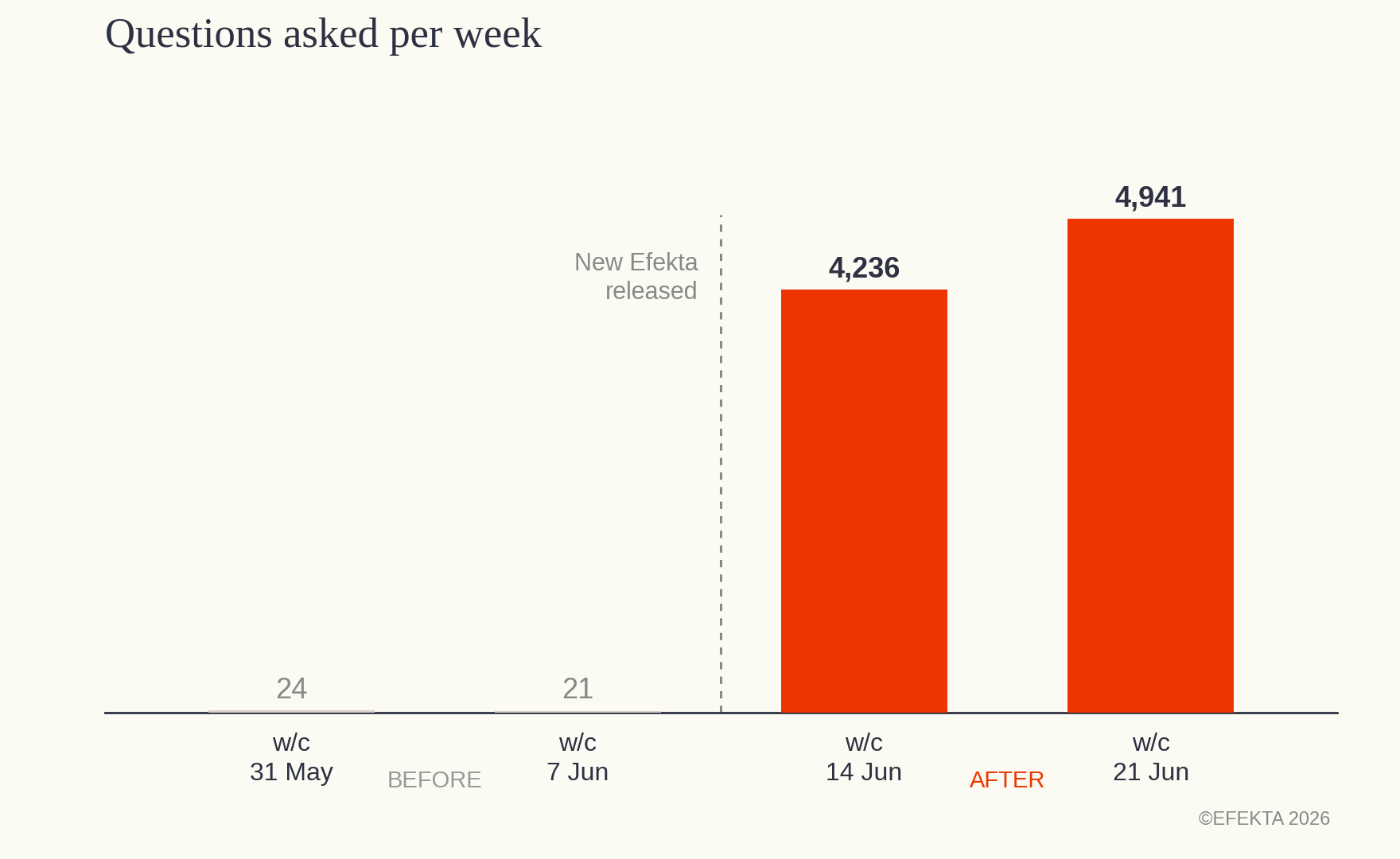
Obviously, we are still some ways from the 26 questions per hour Graesser and Person recorded. But this is a big step in the right direction. And already ~20x the questions asked in a normal classroom.
For me the lesson is that the question-asking Graesser and Person observed doesn’t come from access to a tutor. It comes from comfort with one. So, if you get the relationship right, the questions, and the learning, follow.
Originally posted on LinkedIn.